

Two prominent examples of government-supported programmes are the United States’ Small Business Investment Company (SBIC) system and Hungary’s Startup Factory programme. These systems operate in different economic environments, but both aim to strengthen the local innovation ecosystem and support businesses.
SBIC Programme: The American hybrid financing model
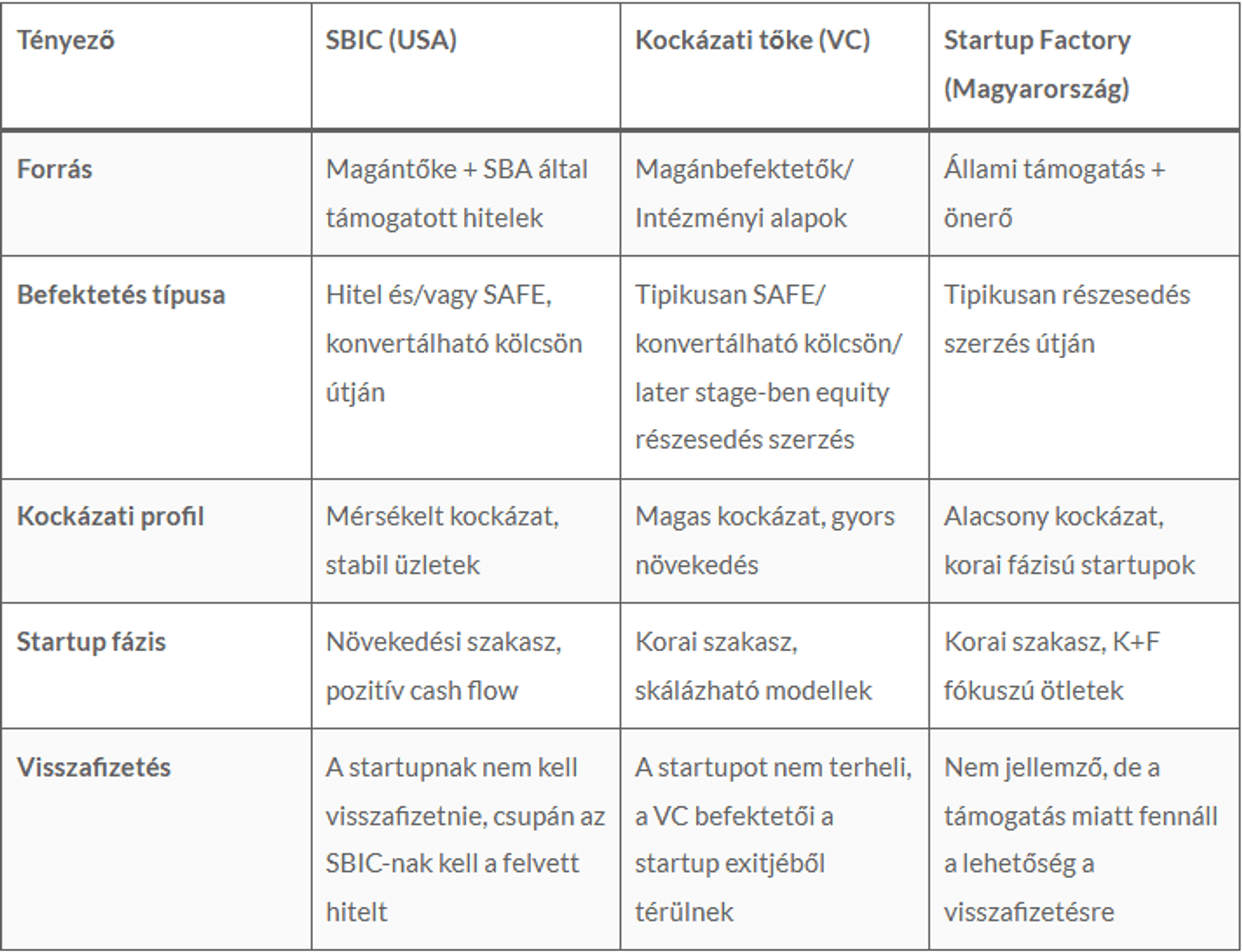
The SBIC programme was established in 1958 and is a hybrid financing model that combines private capital with government-backed loans, known as debentures. SBICs are privately managed investment funds that raise capital from investors, after which the United States Small Business Administration (SBA) may provide up to twice that amount as supplementary financing. This financial leverage enables SBICs to invest in startups and small businesses with moderate growth and positive cash flow, which may not necessarily meet the requirements of traditional venture capital investment.
How does the SBIC work?
- Financing structure: SBICs first raise private capital and then apply for SBA-backed loans. By way of example, after raising USD 50 million in private capital, an SBIC may obtain up to USD 100 million in SBA-backed loans, giving it USD 150 million available for investments.
- Investment strategy: SBICs typically prefer businesses with moderate risk and stable cash flow over explicitly high-risk, high-return startups. Investments usually consist of a combination of equity and debt financing.
- Repayment obligation: SBICs must repay the loans received within 10 years, at a fixed interest rate, typically 6–7 percent. This is essentially why they avoid high-risk investments.
Startups supported by SBICs – there are exceptions to risk avoidance
Several major companies received early financing from SBICs, including:
- Apple – an SBIC investment helped launch the Apple II computer.
- Intel – SBIC financing supported early semiconductor developments.
- FedEx – an SBIC investment enabled the expansion of its logistics network.
Startup Factory: The Hungarian model
Unlike the SBIC, Hungary’s Startup Factory is an accelerator programme based on non-refundable grants, indirectly supporting early-stage Hungarian startups with high potential through state resources. It does so by requiring incubators to also provide their own capital. The aim of the programme is to provide businesses with direct financing, mentoring and infrastructure through incubators.
Which model is best for a startup?
- If the startup is still in the early development phase → Startup Factory offers non-refundable grants, but due to the involvement of grant funding, it comes with structured reporting obligations and therefore administrative burdens.
- In the case of a business with stable growth → The SBIC offers organised financing with less dilution than traditional VC models.
- If the founder is building a high-risk tech startup with significant growth potential → Venture capital (VC) is the best solution for aggressive scaling and global expansion.
How does Startup Factory work?
- Financing structure: The Hungarian government, through the NKFIH, the National Research, Development and Innovation Office, provides financing to incubators such as White Unicorn and STRT Invest. These incubators then select the startups in which they typically acquire a shareholding while also risking their own capital, and use the awarded grant funding to support the given startup.
- Investment strategy: Startups may use the grants only for business development, such as R&D, mentoring and market entry, but incubators may not purchase shareholdings from existing owners. This is because a capital increase and a share purchase are legally different transactions: in the former, the startup receives the money, while in the latter, a member of the startup sells their shareholding for money.
- No repayment obligation: Unlike the SBIC, Startup Factory grants are non-refundable and operate as state aid.
Startups supported by Startup Factory
- Diverzum – an innovative retail analytics company supported by MBH Incubator.
- Compocity and Péntech – fintech and environmental startups financed by Hungarian incubator programmes.
SBIC vs. VC vs. Startup Factory: Which is the best financing model for startups?
Summary
Whatever model we are talking about, the essence is always the same: capital is needed in order for an idea to become a real, successful business. Which of the models presented above is available to a startup depends on the rules of the given country. The task of startups is to make the most of the opportunities available to them. In the end, what matters is who can truly create something great.
This article was published in cooperation between PV Partners Law Firm and KockázatiTőke.com.
The cover image was created using artificial intelligence.