

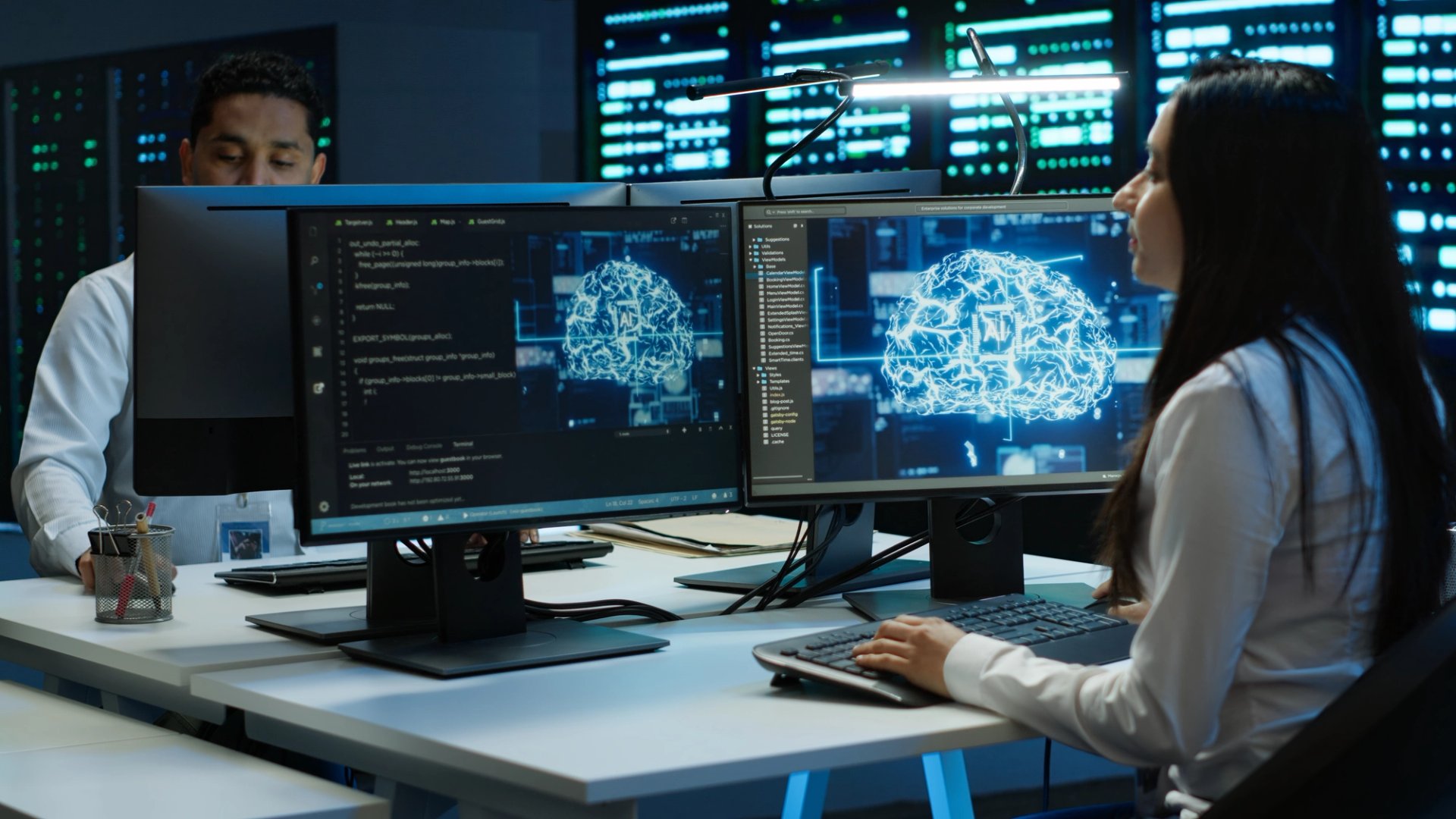
Artificial intelligence hereinafter: AI has by now become an integral part of everyday life and has transformed almost every industry in recent years. Algorithm-driven systems are capable of creating texts, images, music, or even software code, and they no longer merely support inventive processes but may also independently generate inventions.
This development opens new dimensions in the field of intellectual property law and, at the same time, raises highly complex questions, ranging from the identification of the person creating a work or invention to the availability of patent protection. All of this gives rise to significant copyright and industrial property challenges, which must be addressed with increasing awareness, particularly in a rapidly changing technological and legal environment.
Frequently Asked Questions
At the intersection of artificial intelligence, algorithms, and intellectual property law, a number of complex legal questions arise. Below, we present the issues most frequently encountered in practice and the current legal approaches relating to them.
One of the most important questions is whether content and inventions generated by AI can be protected by intellectual property rights at all, meaning whether they may be subject to copyright or patent protection.
According to the legal practice of the European Union, copyright protection traditionally applies to “original” works. Consequently, under the current interpretation of the law, copyright protection is linked to a human creator. Copyright law is based on the principle that, by definition, the author may only be a natural person; therefore, protection directly belongs to the creator as a natural person.
Accordingly, one of the key points of distinction in assessing the above questions is the existence and extent of human contribution. As a result, the smaller the role played by a human in the creative or inventive process, the more uncertain the possibility of copyright or patent protection becomes in relation to the given work or invention.
It is important to emphasise, however, that the legal practice of the European Union in this respect is still developing and may vary from case to case. In certain cases, AI appears merely as a tool used alongside a human creator, while in other cases it already assumes an autonomous decision-making role in the creative or innovation process. This significantly complicates the assessment of whether protection may be granted.
A further question may arise as to who qualifies as the author or who may be regarded as the holder of patent rights if AI-generated content or an AI-generated invention is capable of protection. In the case of works created through the joint involvement of AI and humans, it is particularly difficult to determine whether authorship in the legal sense belongs to the developer, the user, the client, or possibly another third party.
Similar questions may arise in the field of patent law regarding who is entitled to file a patent application and who is entitled to the related moral and economic rights if an AI system played a significant role in the creation of the invention. Another central issue is whether AI-generated inventions created autonomously, that is, without human intervention, can be patented at all.
Training Artificial Intelligence Systems, the Use of Copyrighted Works, and the Opt-Out System
In connection with the first set of questions, another important issue concerns the use of copyrighted works for the training of artificial intelligence systems and the assessment of where the boundary lies between lawful data use and infringing use.
One of the greatest challenges is that the training of artificial intelligence systems is typically based on the use of extremely large volumes of content, which in many cases is protected by copyright. This raises the question of whether such works may be lawfully used or integrated into databases without infringing the rights of the rights holders or without their consent.
The current regulatory framework allows certain forms of text and data mining TDM. Under this framework, as a general rule, the reproduction or extraction of copyrighted content is permitted if it is carried out for the purpose of automated processing, for example for the training of AI systems.
However, text and data mining may place authors of individual works in a vulnerable position. To address this, the new regulatory framework introduced an important limitation, the so-called “opt-out” system. Under this system, rights holders may reserve their rights and prohibit the use of their works for such purposes.
In such cases, the training of artificial intelligence systems using protected works covered by such a reservation is lawful only with the appropriate authorisation. The practical application of this limitation raises a number of questions; nevertheless, the structure may also provide a balanced solution for certain authors.
Summary
Due to the growing prevalence of artificial intelligence, questions at the boundary of innovation, data use, the protection of copyrighted works, and industrial property protection are becoming increasingly significant in the field of intellectual property law.
Overall, the legal assessment of AI-generated content and inventions may differ from case to case and most often depends on the specific circumstances of the matter concerned. For this reason, conscious legal planning is particularly important, especially in preparing appropriate contracts, internal policies, and the steps necessary to obtain trademark protection within the complex system of intellectual property law.
Furthermore, the issue of copyrighted works used in the training of artificial intelligence systems, as well as the application of the related exception regime, requires a new form of balance between encouraging innovation and protecting rights holders.
All of this highlights that the development of intellectual property law and artificial intelligence involves a continuous search for balance, which is expected to further deepen the legal and practical questions faced by businesses in the future.